Click here to see how the population changed since you moved to Teaneck

When did you move to Teaneck?

2000-09
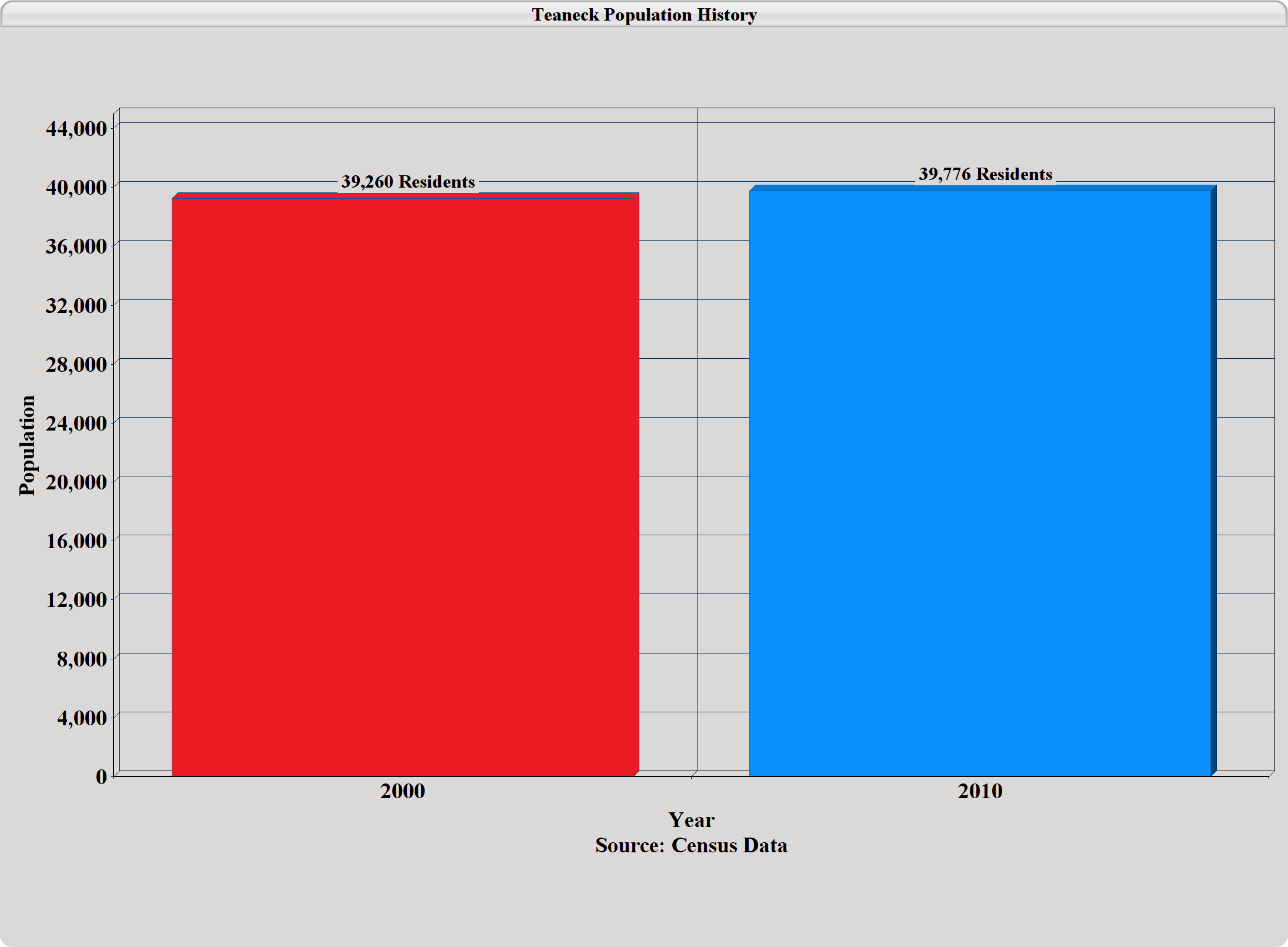
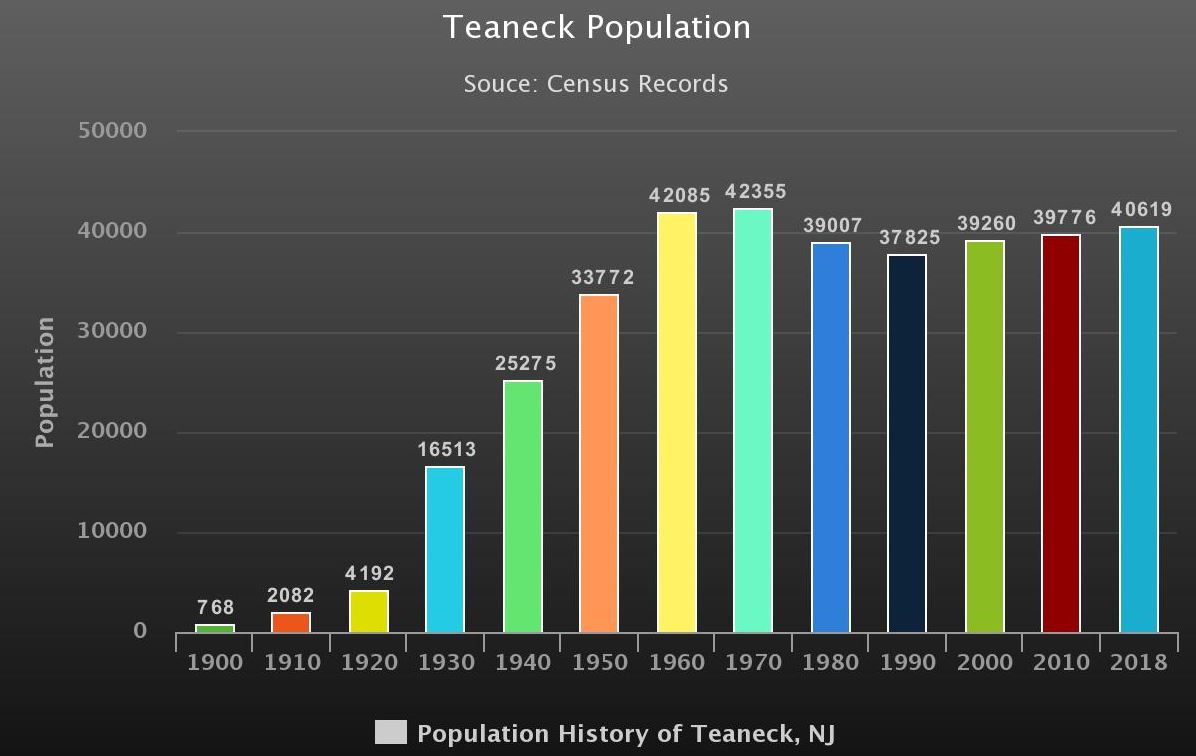
  • The 2000 Census indicates 39,260 residents living in Teaneck.
  • The 2010 Census indicates 39,776 residents.
    • An increase of 516 residents

1990-99
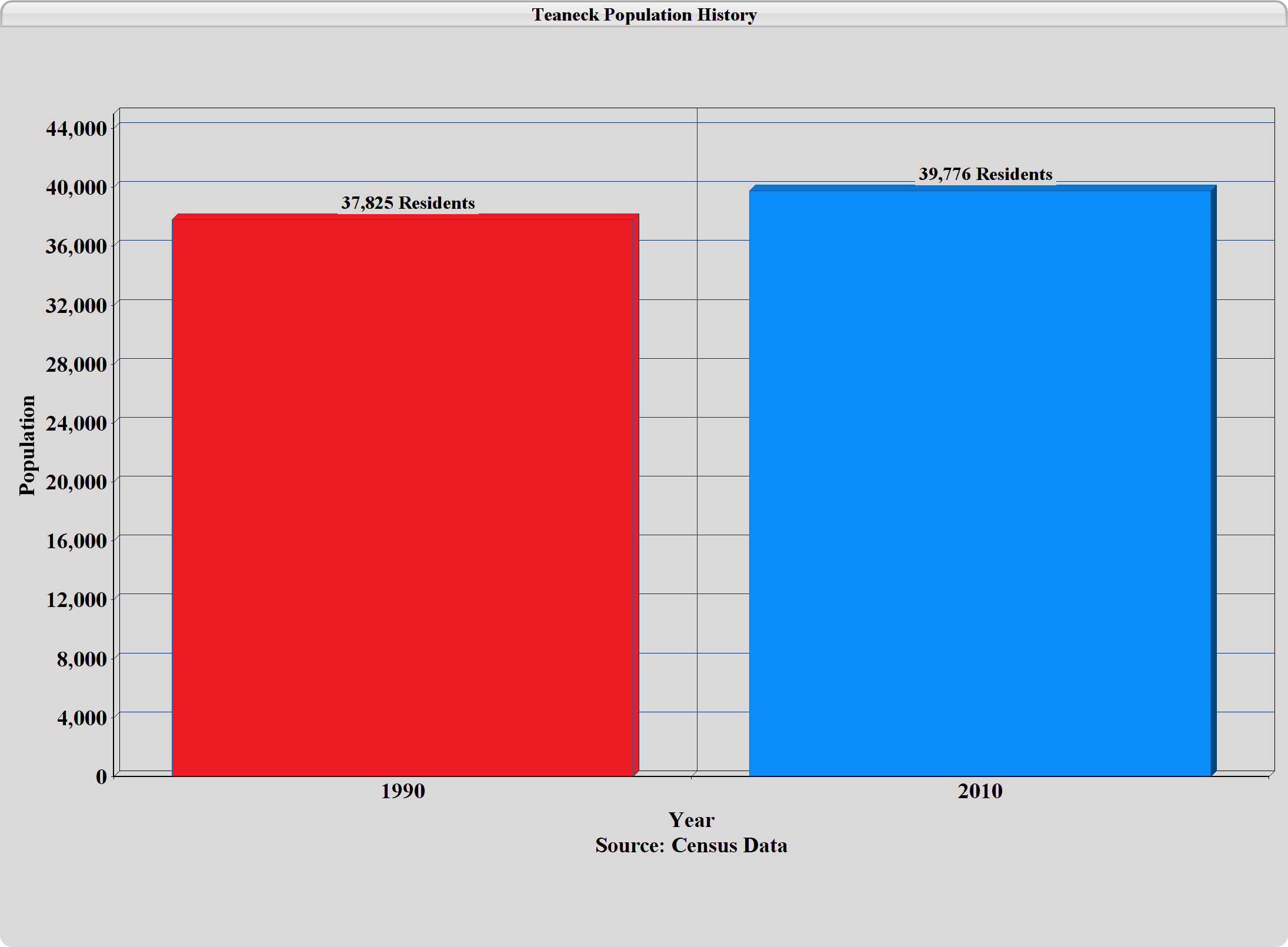
  • The 1990 Census indicates 37,825 residents living in Teaneck.
  • The 2010 Census indicates 39,776 residents.
    • An increase of 1,951 residents

1980-89
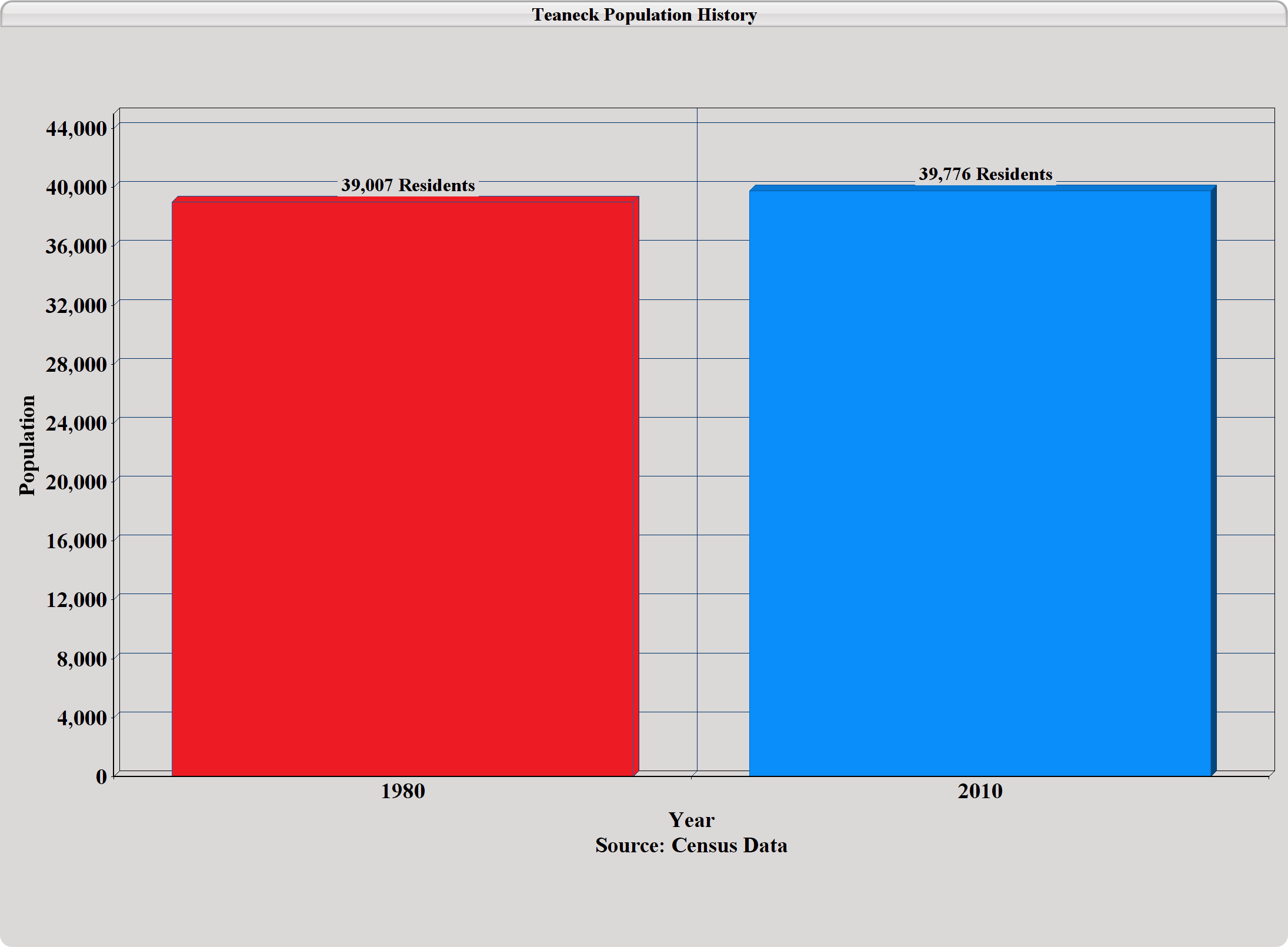
  • The 1980 Census indicates 39,007 residents living in Teaneck.
  • The 2010 Census indicates 39,776 residents.
    • An increase of 769 residents

1970-79
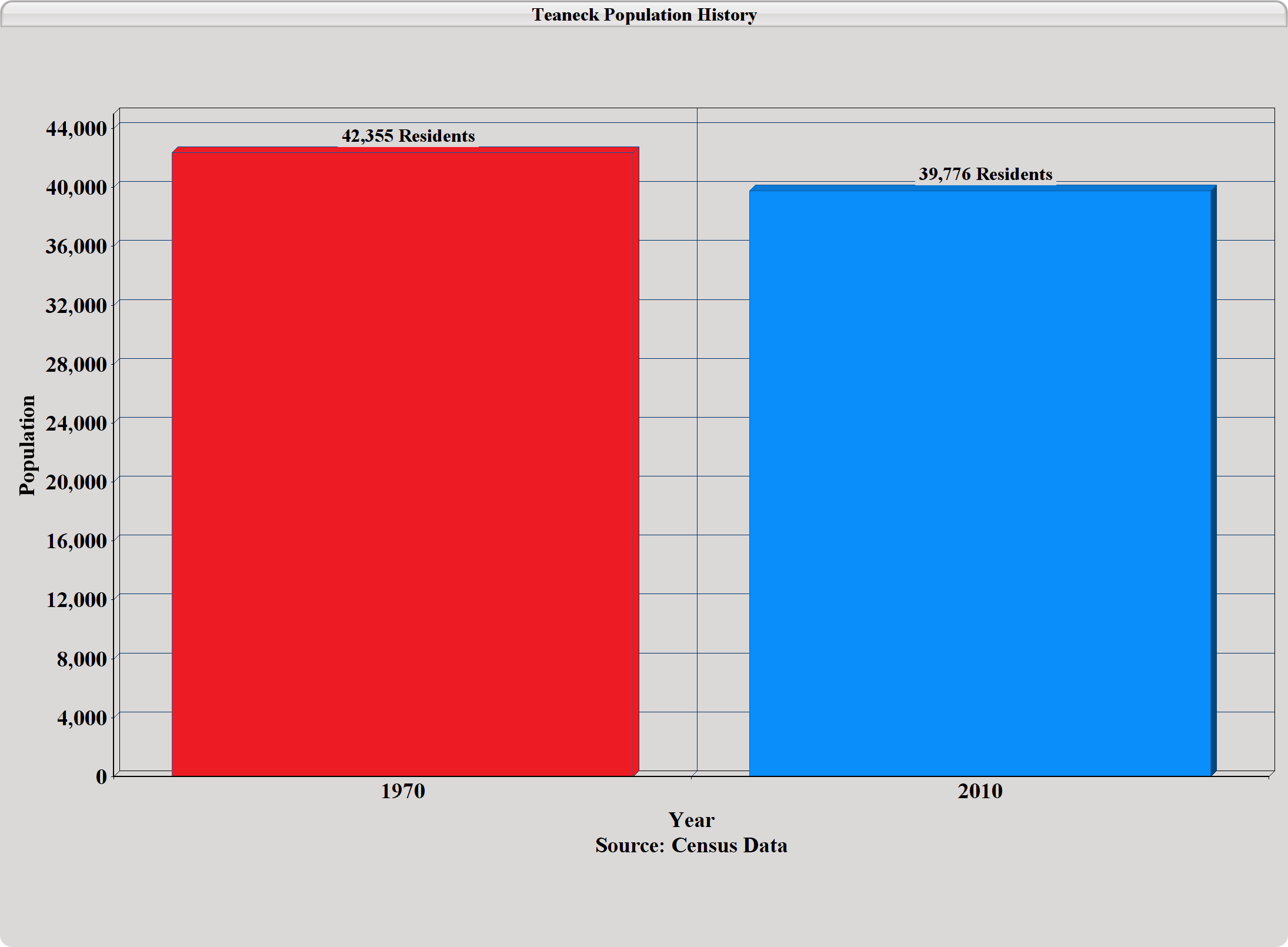
  • The 1970 Census indicates 42,355 residents living in Teaneck.
  • The 2010 Census indicates 39,776 residents.
    • An decrease of 2,579 residents

The 1960’s – 70’s were the most populous period in Teaneck history.
1960-69
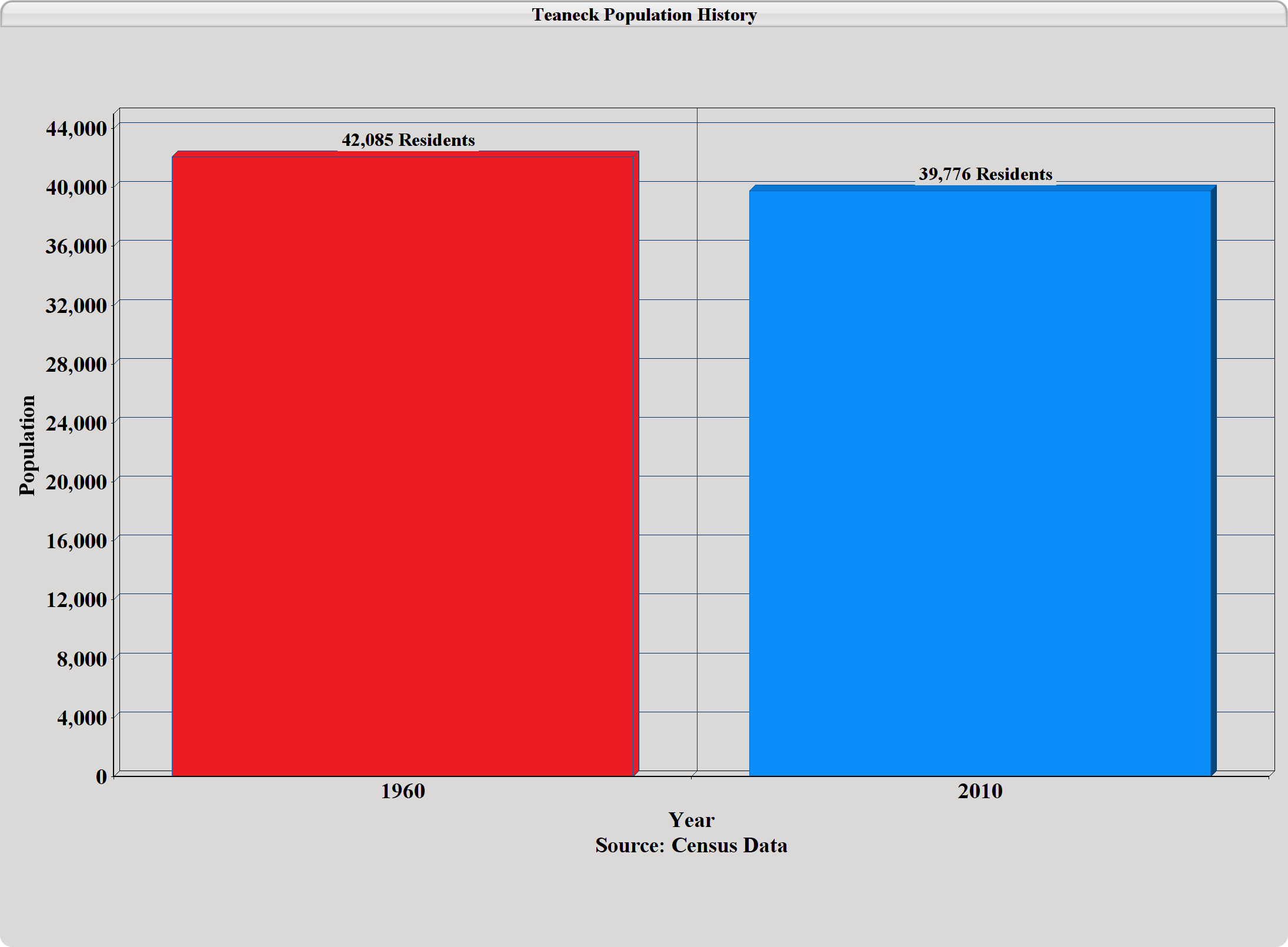
  • The 1960 Census indicates 42085 residents living in Teaneck.
  • The 2010 Census indicates 39,776 residents.
    • An decrease of 2,309 residents

The 1960’s – 70’s were the most populous period in Teaneck history.
1950-59
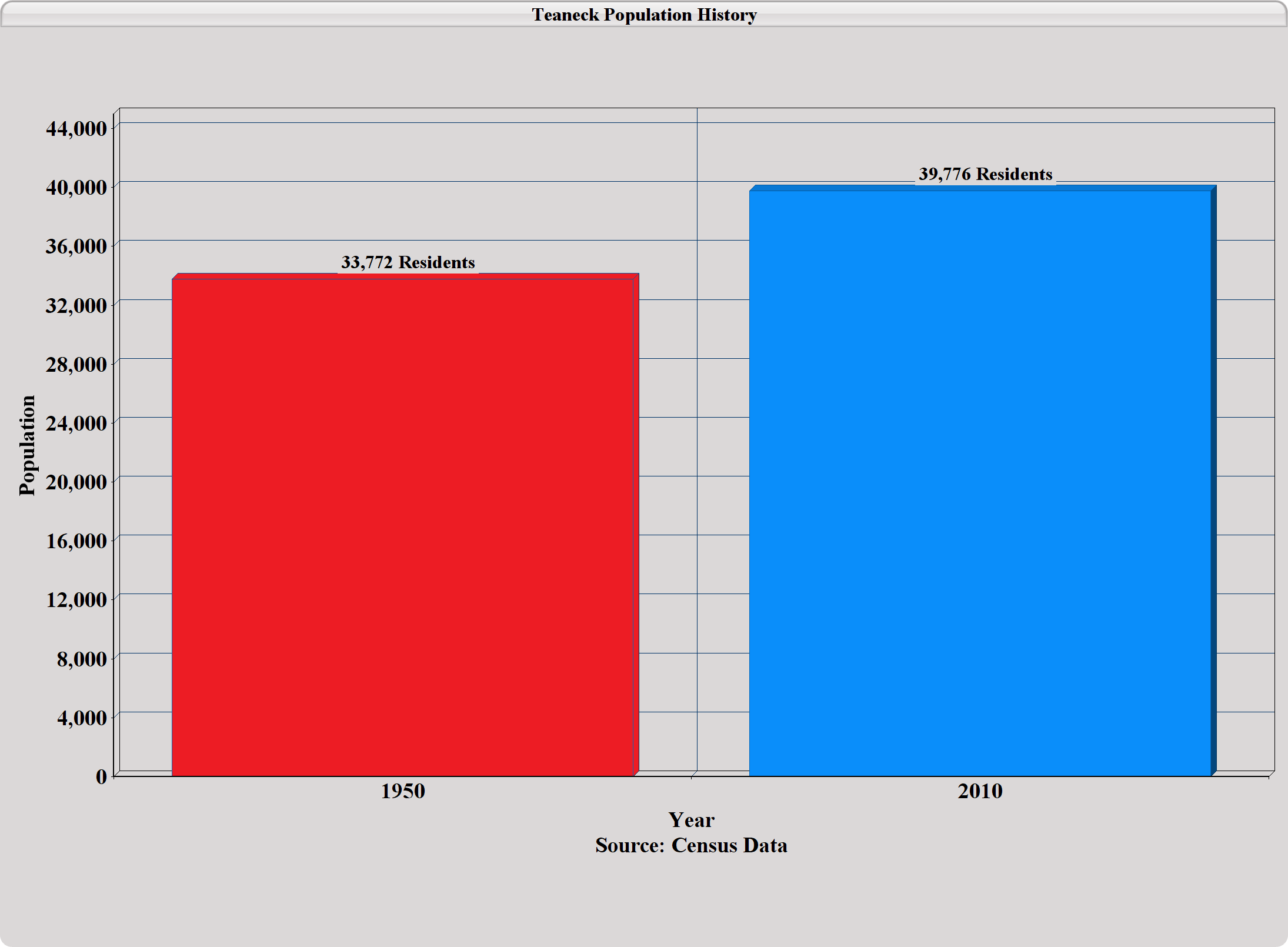
  • The 1950 Census indicates 33,772 residents living in Teaneck.
  • The 2010 Census indicates 39,776 residents.
    • An increase of 6,004 residents

The 1950’s – 60’s were the second most populous period in Teaneck history.
1940-49
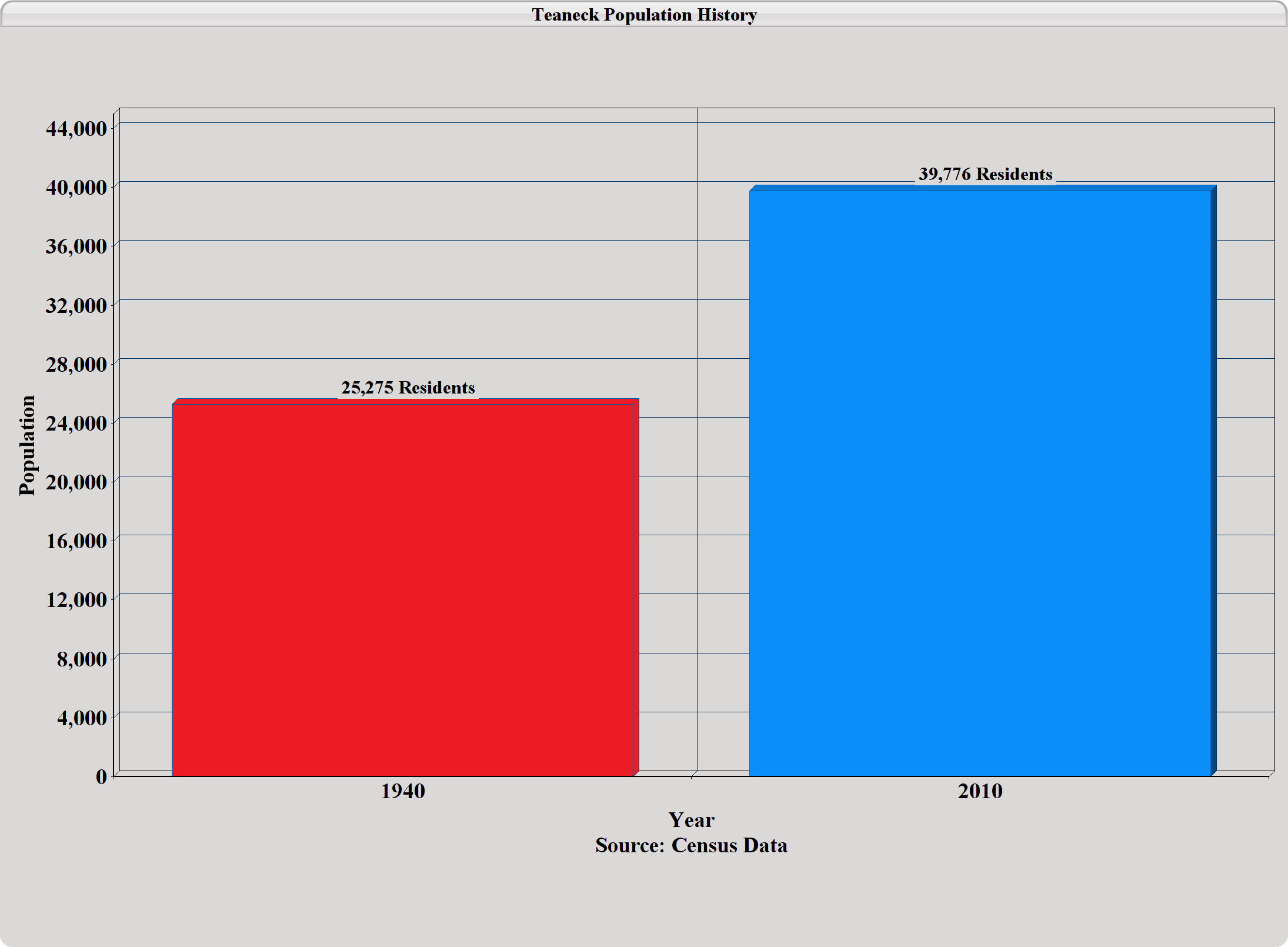
  • The 1940 Census indicates 25,275 residents living in Teaneck.
  • The 2010 Census indicates 39,776 residents.
    • An increase of 14,501 residents

1930-39
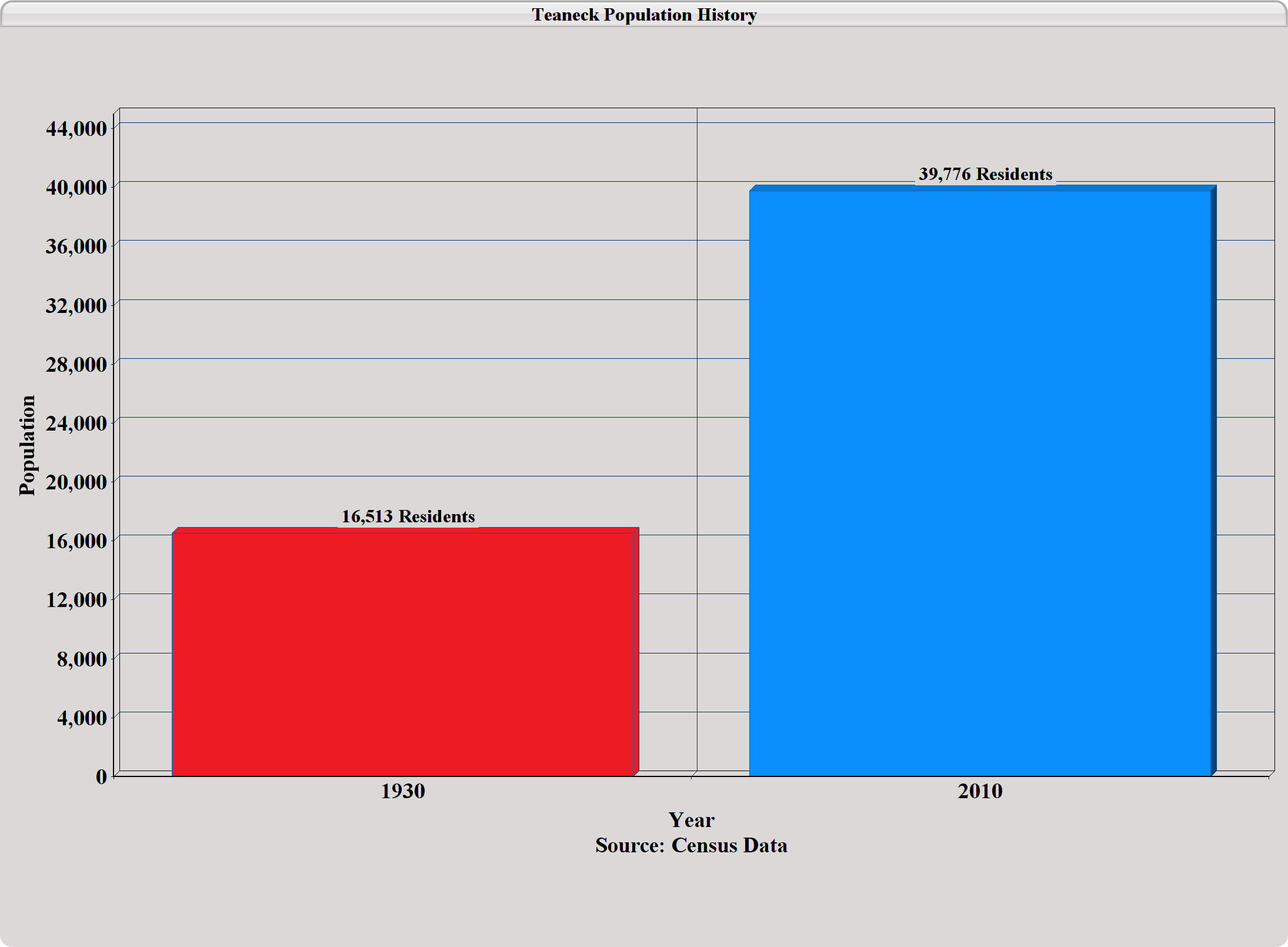
  • The 1930 Census indicates 16,513 residents living in Teaneck.
  • The 2010 Census indicates 39,776 residents.
    • An increase of 23,263 residents

There were a mere 16,,513 residents in Teaneck back in the 1930’s.  It was a decade that saw the GWB and Rt. 4 open, as well as a large amount of land owned by the Phelps estate, make its way to the market for development.

By 1940, there were 25,275 residents in Teaneck, representing a growth in Teaneck’s population of nearly 394%.
How many people live in Teaneck?

Population Data

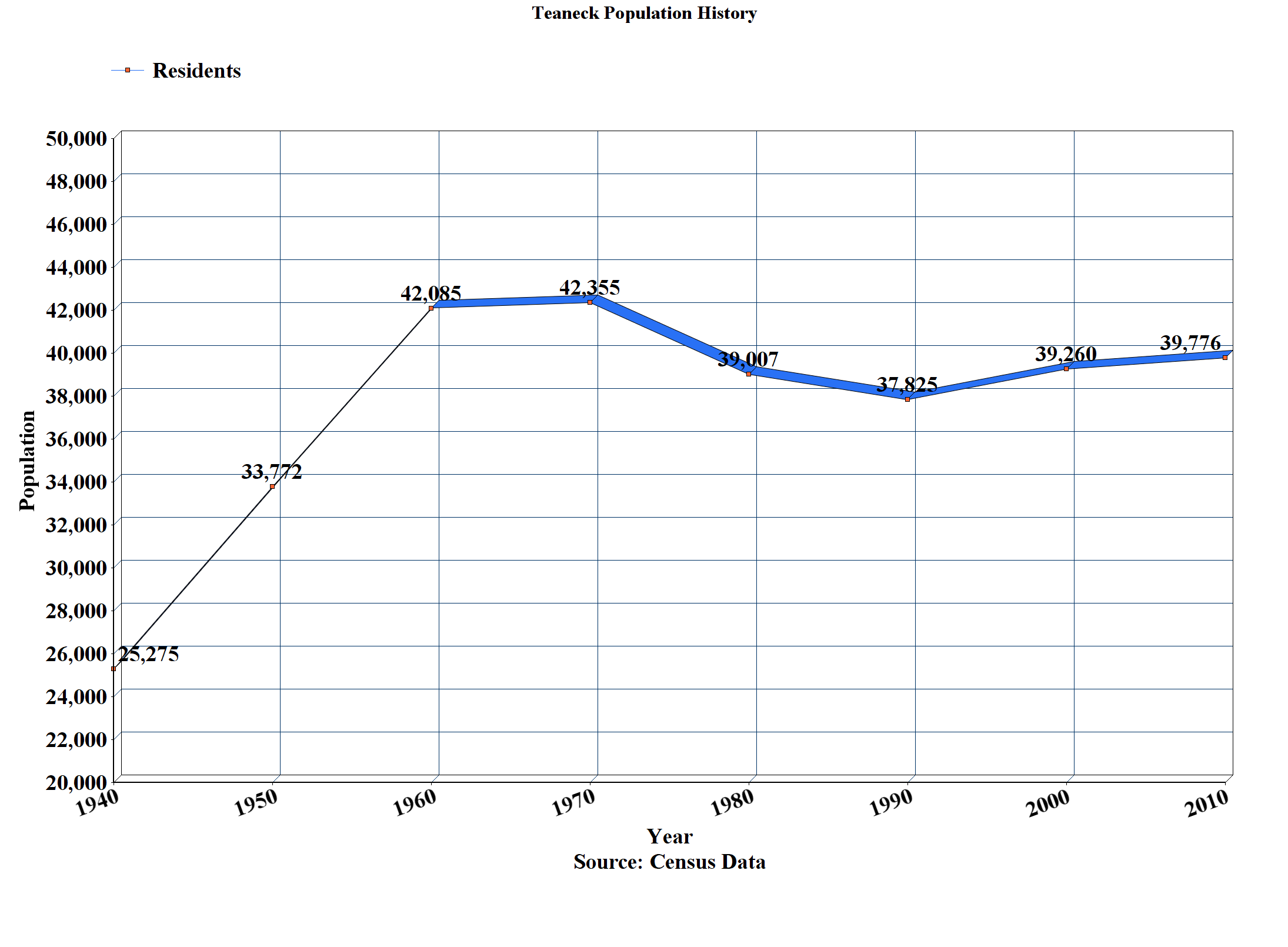
We’ll get a better sense after the 2020 Census, but here are our population data (by decade).

When did you move to Teaneck?

2000-09
  • The 2000 Census indicates 39,260 residents living in Teaneck.
  • The 2010 Census indicates 39,776 residents.
    • An increase of 516 residents

1990-99
  • The 1990 Census indicates 37,825 residents living in Teaneck.
  • The 2010 Census indicates 39,776 residents.
    • An increase of 1,951 residents

1980-89
  • The 1980 Census indicates 39,007 residents living in Teaneck.
  • The 2010 Census indicates 39,776 residents.
    • An increase of 769 residents

1970-79
  • The 1970 Census indicates 42,355 residents living in Teaneck.
  • The 2010 Census indicates 39,776 residents.
    • An decrease of 2,579 residents

The 1960’s – 70’s were the most populous period in Teaneck history.

1960-69
  • The 1960 Census indicates 42085 residents living in Teaneck.
  • The 2010 Census indicates 39,776 residents.
    • An decrease of 2,309 residents

The 1960’s – 70’s were the most populous period in Teaneck history.

1950-59
  • The 1950 Census indicates 33,772 residents living in Teaneck.
  • The 2010 Census indicates 39,776 residents.
    • An increase of 6,004 residents

The 1950’s – 60’s were the second most populous period in Teaneck history.

1940-49
  • The 1940 Census indicates 25,275 residents living in Teaneck.
  • The 2010 Census indicates 39,776 residents.
    • An increase of 14,501 residents

1930-39
  • The 1930 Census indicates 16,513 residents living in Teaneck.
  • The 2010 Census indicates 39,776 residents.
    • An increase of 23,263 residents

There were a mere 16,,513 residents in Teaneck back in the 1930’s.  It was a decade that saw the GWB and Rt. 4 open, as well as a large amount of land owned by the Phelps estate, make its way to the market for development.

By 1940, there were 25,275 residents in Teaneck, representing a growth in Teaneck’s population of nearly 394%.

(↑) indicated an increase over the prior decade
() indicates a decrease over prior decade

Decade Population Change from prior decade (%) Change from prior decade (#)
2020 41,246 (↑) 103.70% +  1,470
2010 39,776 (↑) 101.31% +  516
2000 39,260 (↑) 103.79% + 1,435
1990 37,825 () 96.97% –  1,182
1980 39,007 () 92.10% –  3,348
1970 42,355 (↑) 100.64% +   270
1960 42,085 (↑) 124.62% + 8,313
1950 33,772 (↑) 133.62% + 8,497
1940 25,275 (↑) 153.06% + 8,762
1930 16,513 (↑) 393.92% +12,321
1920   4,192 (↑) 201.34% + 2,110
1910   2,082 (↑) 271.09% + 1,314
1900     768

(* 2018 figure is an estimate from census.gov)

How many kids attend our public schools

Every year, the Teaneck School District submits a document called the Annual Comprehensive Financial Report (ACFR*).

The most recent one available is for the Fiscal Year ending June 30, 2023.
You can access the entire report here.

The ACFR show Teaneck Schools enrollment is down 18.83% (840 students) since 2001*

(* The 2001 CAFR report was the earliest report available online at the Department of Education website, although the downward trend in enrollment has been noted for decades)

These are the enrollment numbers in the CAFR:

Fiscal Year Student Enrollment Percent Change
2022/23 3915 1.93%
2021/22 3841 -1.92%
2020/21 3916 -0.28%
2019/20 3927 0.69%
2018/19 3900 -1.84%
2017/18 3,973 0.40%
2016/17 3,957 -1.54%
2015/16 4,019 -1.30%
2014/15 4,072 -0.63%
2013/14 4,098 -0.80%
2012/13 4,131 -1.60%
2011/12 4,198 -2.55%
2010/11 4,308 2.77%
2009/10 4,192 -2.15%
2008/09 4,284 -1.52%
2007/08 4,350 -2.95%
2006/07 4,482 -0.97%
2005/06 4,526 -0.11%
2004/05 4,531 -2.05%
2003/04 4,626 -1.26%
2002/03 4,685 -1.16%
2001/02 4,740 -0.8%

* The report was called the Comprehensive Annual Financial Report (CAFR) prior to 2023

How is the Mayor (or Deputy Mayor) chosen?1

After each council election, the newly constituted council appears on a day in the first week of January to “reorganize“.

At the reorganization meeting, all 7 council-members will choose from among themselves, a Mayor and two deputy mayors.

In our form of Government (under the Faulkner Act):

The Mayor shall preside at all meetings of the Council and shall have a voice and a vote in its proceedings but shall not have the power of veto. The Mayor shall appoint the members of and fill vacancies in the Library Board and shall appoint the Class II member of the Planning Board and shall sit as the Class I member of the Planning Board. All bonds, notes, contracts and written obligations of the Township shall be executed on its behalf by the Mayor or, in the event of the absence or disability of the Mayor, by the Deputy Mayor I or, in the event of the absence or disability of both the Mayor and Deputy Mayor I, by the Deputy Mayor II. The term of the Mayor, Deputy Mayor I and Deputy Mayor II shall be for two years and shall expire upon the election of a successor at the next organizational meeting of the Council. If a vacancy occurs in the office of Mayor, by reason of death, resignation or otherwise, the Deputy Mayor I or, in the absence of the Deputy Mayor I, then the Deputy Mayor II shall become the acting Mayor, with all the powers and duties of the Mayor, until a successor Mayor is elected and qualified at the next reorganizational meeting.
Section 2-15 of the Teaneck Code

Not necessarily.

There is a commonly held belief that the individual elected with the highest number of votes should become mayor, but there is very little support for this in law or history.

1930 to 1988

From 1930 when our Town adopted the Council-Manager form of government to 1988 (when we switched to the current Faulkner act), we elected 5 members of council, every 4 years, to serve for four year terms.

This is how the law worked back then:

  1.  All members were elected in a single election.
  2. The council would try electing a Mayor from among themselves.
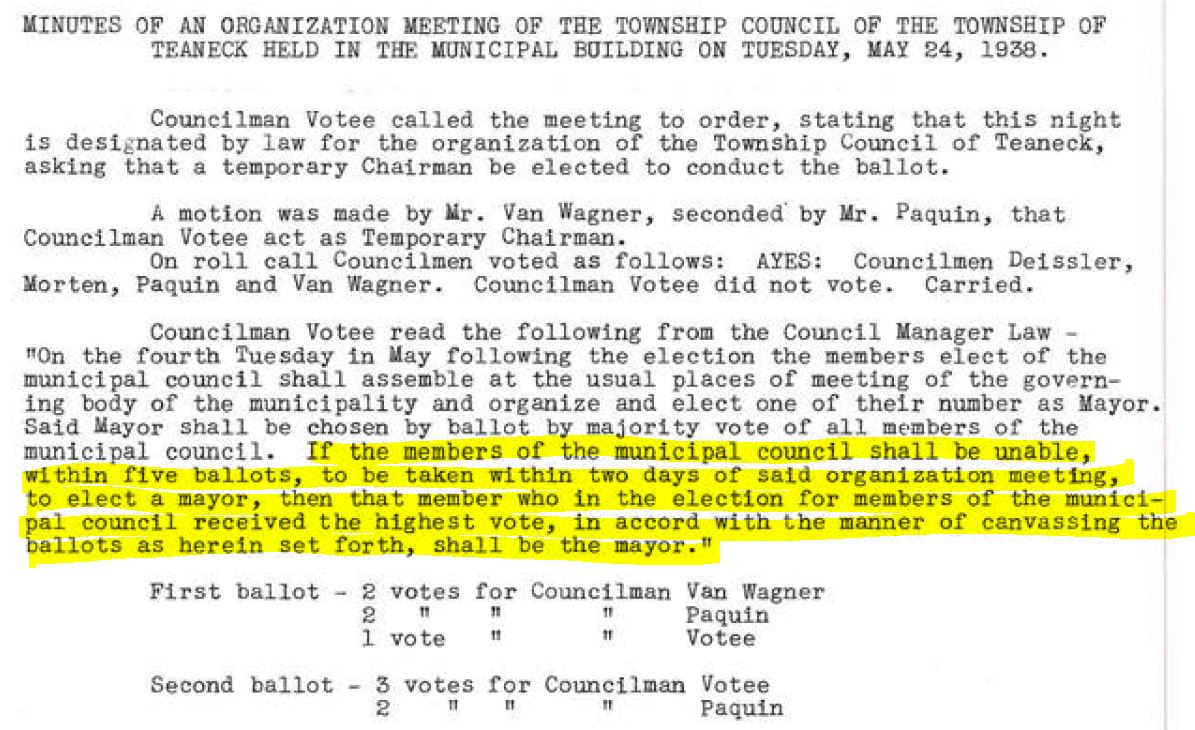
  3. If they couldn’t choose a mayor, the highest vote recipient would be chosen as mayor.

1988 to Present

In 1988, after a referendum was passed to proceed under the Faulkner Act, elections were staggered, so only a portion of the council would be elected every other year.

Because council members were not all chosen at the same time, this change made any determination of which member received the “highest number of votes” impossible.

Historical Evidence

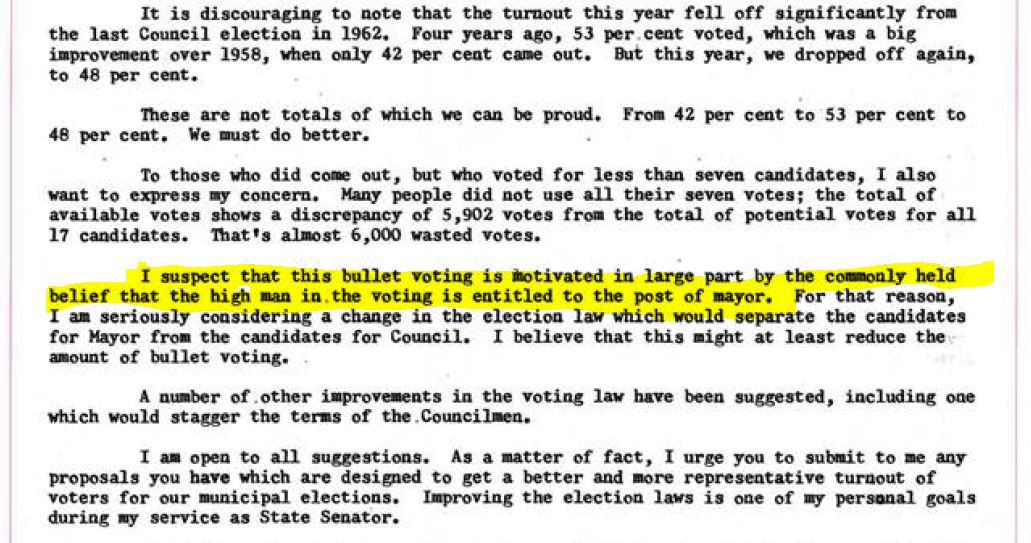
May, 1966: In his address to the Township, Mayor Feldman lamented the lack of turnout in elections.  He noted that in the 1960’s turnout dipped below 50% of registered voters and wondered what could be done to help halt the trend.  In his speech, he referenced the issue of public misconceptions.

“I suspect that this bullet voting is motivated in large part by the commonly held belief that the high man in the voting is entitled to the post of mayor.”
– Matthew Feldman

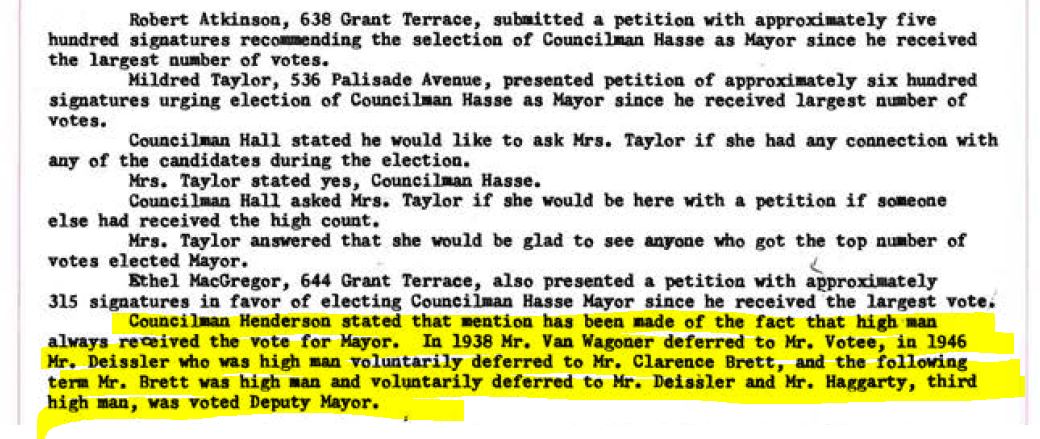
In response, Councilman Henderson gave a brief historical record of the issue.

Councilman Henderson stated that “mention has been made of the fact that high man always received the vote for Mayor. In 1938, Mr. Van Wagner deferred to Mr. Votee, in 1946, Mr. Deissler who was high man voluntarily deferred to Mr. Clarence Brett, and the following term Mr. Brett was high man and voluntarily deferred to Mr. Deissler and Mr. Haggerty, third high man, was voted Deputy Mayor.”

When a resident later asked “if there was a written law on elected officials that the Councilman with the highest number of votes be elected Mayor“, Mayor Costa replied:

“It was not necessarily the Councilman with the highest number of votes.”

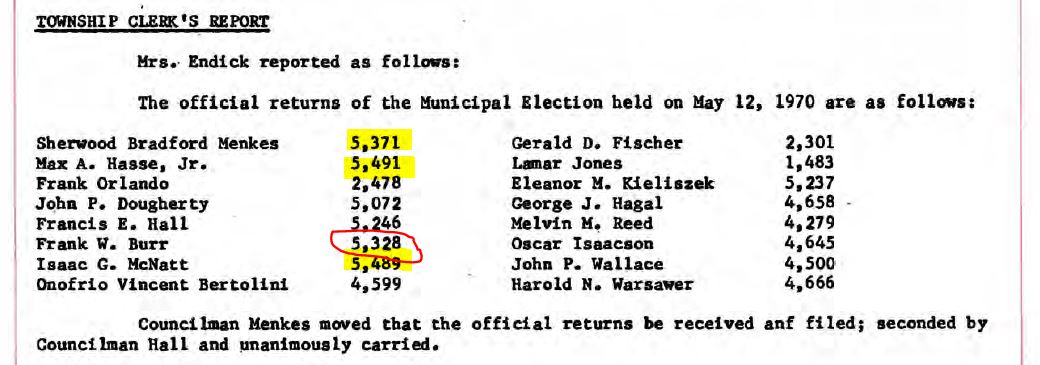
In the 1970, even before the 1988 referendum, we can see it was not the policy to elect the highest vote recipient as Mayor.

Here are the election results from the 1970 election:

Each of the highlighted council-members had a higher vote count than Mayor Burr.

So if someone tells you that the highest person should become Mayor, point them here.


Does the highest vote recipient become mayor?

Not necessarily.

There is a commonly held belief that the individual elected with the highest number of votes should become mayor, but there is very little support for this in law or history.

1930 to 1988

From 1930 when our Town adopted the Council-Manager form of government to 1988 (when we switched to the current Faulkner act), we elected 5 members of council, every 4 years, to serve for four year terms.

This is how the law worked back then:

  1.  All members were elected in a single election.
  2. The council would try electing a Mayor from among themselves.
  3. If they couldn’t choose a mayor, the highest vote recipient would be chosen as mayor.

1988 to Present

In 1988, after a referendum was passed to proceed under the Faulkner Act, elections were staggered, so only a portion of the council would be elected every other year.

Because council members were not all chosen at the same time, this change made any determination of which member received the “highest number of votes” impossible.

Historical Evidence

May, 1966: In his address to the Township, Mayor Feldman lamented the lack of turnout in elections.  He noted that in the 1960’s turnout dipped below 50% of registered voters and wondered what could be done to help halt the trend.  In his speech, he referenced the issue of public misconceptions.

“I suspect that this bullet voting is motivated in large part by the commonly held belief that the high man in the voting is entitled to the post of mayor.”
– Matthew Feldman

In response, Councilman Henderson gave a brief historical record of the issue.

Councilman Henderson stated that “mention has been made of the fact that high man always received the vote for Mayor. In 1938, Mr. Van Wagner deferred to Mr. Votee, in 1946, Mr. Deissler who was high man voluntarily deferred to Mr. Clarence Brett, and the following term Mr. Brett was high man and voluntarily deferred to Mr. Deissler and Mr. Haggerty, third high man, was voted Deputy Mayor.”

When a resident later asked “if there was a written law on elected officials that the Councilman with the highest number of votes be elected Mayor“, Mayor Costa replied:

“It was not necessarily the Councilman with the highest number of votes.”

In the 1970, even before the 1988 referendum, we can see it was not the policy to elect the highest vote recipient as Mayor.

Here are the election results from the 1970 election:

Each of the highlighted council-members had a higher vote count than Mayor Burr.

So if someone tells you that the highest person should become Mayor, point them here.