Archives: FAQs
Youth Programs
Sports Programs
Facilities Information / Applications
Adult Rec Programs
Who must file an FDS?
Section 40A:9-22.3 lays out the definition of “Local Government Officer”. It includes members of council as well as statutory boards, such as the Planning Board or Zoning Board of Adjustment.
Click here to see the definition of Local Government Officer“Local government officer” means any person whether compensated or not, whether part-time or full-time:
(1) elected to any office of a local government agency;
(2) serving on a local government agency which has the authority to enact ordinances, approve development applications or grant zoning variances;
(3) who is a member of an independent municipal, county or regional authority; or
(4) who is a managerial executive or confidential employee of a local government agency, as defined in section 3 of the “New Jersey Employer-Employee Relations Act,” P.L.1941, c.100 (C.34:13A-3), but shall not mean any employee of a school district or member of a school board
Why did police stop enforcing Teaneck’s orders on how many people can go to Stop & Shop.
In NJ, Towns cannot create rules that violate the express rules set by the County and the County cannot create rules that violate the express rules set by the State.
When rules are created at the County or State level that conflict with the lower level, the State rules will supersede both County and Township rules.
Here is why the rules set up at supermarkets can no longer be enforced in Teaneck:
Town Rules go into Effect on 3/16/20
On March 15th, Teaneck Manager Dean Kazinci issued Township Executive Order declaring a State of Emergency and some initial restrictions.
County Rules go into effect on 3/17/20 create 50 person max at supermarkets
The following day, March 16fh, County Executive Jim Tedesco issued Bergen County Executive Order 2020-1B. This order said, in relevant part:
13) Food establishments or retail establishments that primarily sell food, either fresh or preserved, including but not limited to grocery stores and supermarkets and similar establishments, and the portion of establishments that engage in this activity shall be permitted to remain open between the hours of 11 p.m. and 7 a.m. Food establishments shall be restricted to the sale of food and health care products, and shall prohibit the purchase of any other items. Larger food establishments and supermarkets shall limit the number of patrons within a store to fifty (50) at any one time. Smaller store that are not capable of servicing fifty (50) patrons shall impose an appropriate customer limit to comply with CDC social distancing guidelines. Individual municipalities shall be responsible for the enforcement of the limitations contained in the within paragraph.
State Rules go into effect on 3/21/20 superseding County and Local rules and eliminating 50 person max
On March 21st, Governor Murphy issued State Executive Order #108. It says, in relevant part:
- Any county or municipal restriction imposed in response to COVID-19 that in any way will or might conflict with any of the provisions of Executive Order No. 107 (2020), or which will or might in any way interfere with or impede its achievement, or the achievement of Administrative Orders issued as authorized by my Executive Orders, is hereby invalidated. Examples of such restrictions include, but are not limited to, the following:
- Any additions to or deletions from the list of retail businesses that I have deemed essential or that have been identified as essential through Administrative Orders authorized by my Executive Orders;
- Any limitations imposed on any business’s scope of service or hours of operation;
- Any density or social distancing requirements;
- Any orders relating to the gathering of individuals; and
- general restrictions on the freedom of movement within that county or municipality, including but not limited to the imposition of curfews.
- No municipality, county, or any other agency or political subdivision of this State shall enact or enforce any order, rule, regulation, ordinance, or resolution which will or might in any way conflict with any of the provisions of Executive Order No. 107 (2020), or which will or might in any way interfere with or impede its achievement, or the achievement of Administrative Orders issued as authorized by my Executive Orders
What can we do?
- An appeal to Governor Murphy to allow municipalities the leeway to enact appropriate rules
- A request to individual store managers to voluntarily require such rules
When to use Rates vs Amounts
There are times that rates can provide a quick metric for comparison and times that they are not appropriate.
Two common uses are:
- Tax Rates (limited utility)
– Tax Rates and amount paid do not necessarily flow together
– Rates can vary dramatically between towns based on when they conduct a reval - Debt Rates (fair comparisons)
Tax Rates
These are sample tax rates for Teaneck
| Year | Municipal | School | Total |
| 2006 | 1.592 | 1.220 | 4.640 |
| 2007 | 0.748 | 1.250 | 2.150 |
The rate plummeted from 4.640 to 2.150 between 2006 and 2007. But the budget in those years didn’t get chopped in half.
So what is happening?
| Year | Municipal | School | Total |
| 2006 | $ 41,754,975 | $ 71,404,044 | $ 130,357,925 |
| 2007 | $ 45,134,088 | $ 74,190,491 | $ 133,851,961 |
Revaluation
Tax rates are floating modifiers. They work by taking value of land, comparing it to the current budget and obtaining the relative share from property owners. If your home is worth 2x that of your neighbor, you pay 2x as much in local taxes.
Everyone must pay their fair share, but since value of homes constantly changes, at certain intervals the town is required to find the full and fair value of property.
You can read about the issue on the State website here: What is Revaluation
There is also an explanation of the programs and processes here: Appraisal Systems Inc – Revaluation
Why can’t we just compare tax rates?
Since a revaluation changes the assessed values of homes to their full and fair value, it can affect how much is paid in taxes (since everyone pays a relative amount to everyone else). If your home recently sold, it’s assessment may be an accurate reflection of it’s value. If you have lived there for years, the assessment may need to be updated.
| Assessed Value Of Home | Tax Rate | Amount Paid |
| $277,760 | .025 | $6,944 |
| $555.520 | .0125 | $6944 |
As you can see in the example above, a house that was at full and fair value before an assessment will pay the same local taxes after a reval, although the tax rate will change based on the new assessed values.
Since the tax rate and the amount paid do not necessarily flow together, historical tax rate comparisons offer limited utility.
Since revaluation years vary from Town to Town, you also cannot compare historical tax rates across different communities.
Was there a revaluation during that time that would alter the numbers significantly? If so, looking at budget values is the appropriate metric.
Debt Rates
The amount of authorized debt is very different rate. You can use this to not only compare historical data, but also to compare your data across different municipalities.
In the State of New Jersey, municipalities may bond up to the debt limit, which is 3.5% of the equalized valuation of taxable real estate.
The annual debt statement, allows you to compare historical as well as neighboring municipalities’ percentage of authorized debt, against each other.
You can read more about debt rates here:
How does Teaneck compare to surrounding areas in terms of bonding?
Why Do Municipalities Issue Bonds?
What are Municipal Bonds?
Bonds, are promises to pay an interest rate for certain types of authorized purchases.
If you are building a new school or community center or road, all of which may be used for decades to come, the town may:
- Fund the project with current tax appropriations
- Issue bonds to raise funds for the project over time
An Example:
Let’s take a road resurfacing project. If Teaneck spends $1,000,000 of tax money repaving a mile of roadway, current residents pay that amount, today. On the other hand, if we bond the road resurfacing project, Teaneck will pay that amount over several decades the road is used.
There are several up-sides to bonding a project. One major benefit is that residents moving into town a year or even ten years from now, (who will still benefit from these capital projects), share part of their financing.
That, in essence, is why many refer to bonding as inter-generational equity.
Is there a limit to the amount a town may bond?
Yes, as per the New Jersey Local Bond Law, a municipality may bond up to 3.5% of the equalized valuations of the taxable real estate (40A:2-6).
To see how Teaneck and other local municipalities compare, click here: Bonding: How does Teaneck compare?
What portion of the Tax Bill goes to the Township / Board of Education / County
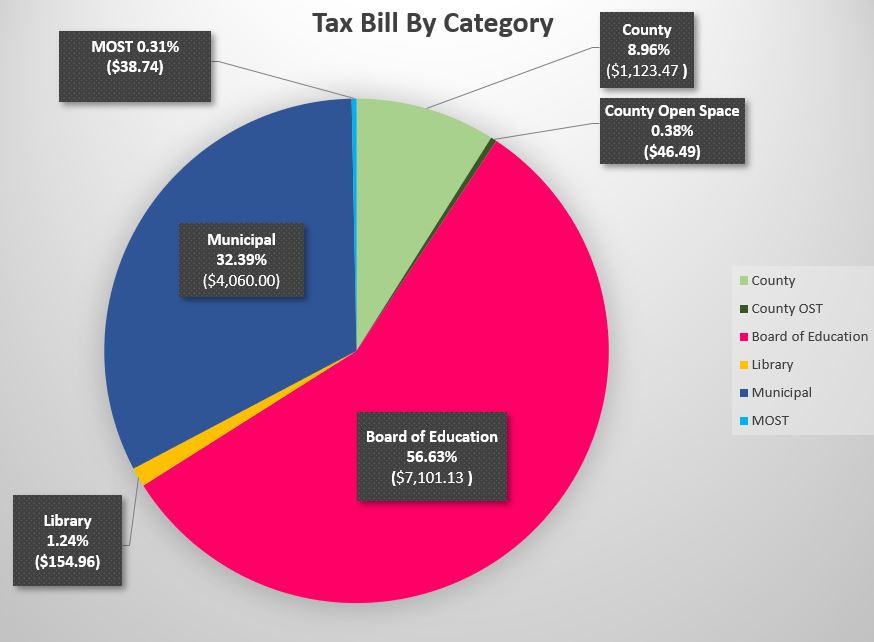
A breakdown of the average tax levy can be found below.
The average residential assessment for 2019 was $384,308.15 and it was $387,405.00 for 2020.
The tax bill for the average assessment breaks down as follows (approx):
| 2020 (%) | 2020 ($) | 2019 (%) | 2019 ($) | |
| Board of Education | 56.63% | $7,101.13 | 56.8% | $6,979.04 |
| Municipal | 32.39% | $4,060.00 | 32.87% | $4,039.08 |
| Municipal Open Space | 0.31% | $38.74 | .31% | $38.43 |
| County | 8.96% | $1,123.47 | 8.48% | $1,041.48 |
| County Open Space | 0.38% | $46.49 | .31% | $38.43 |
| Library | 1.24% | $154.96 | 1.22% | $149.88 |